
A template file is the small PHP file that prints one piece of a page: the logo, the cart panel, the price on a product page. When you need to change what one of them outputs, and no setting or filter can do it, you copy that file into your child theme and edit the copy.
Never edit the file inside the theme or the plugin itself. Those folders are replaced wholesale on every update, and your change goes with them. A child theme is never touched by an update, which is exactly why overrides live there.
Note: No child theme yet? Follow How to install the child theme first. Everything below assumes the child theme is installed and active.
The rule is the same in all three cases: keep the folder structure, change only the destination root. A file two folders deep in the source stays two folders deep in the child theme.
Where each file goes
| Templates from | Copy them into |
|---|---|
/wp-content/plugins/rey-core/template-parts/ | /wp-content/themes/rey-child/rey-core/ |
/wp-content/themes/rey/template-parts/ | /wp-content/themes/rey-child/template-parts/ |
/wp-content/plugins/woocommerce/templates/ | /wp-content/themes/rey-child/woocommerce/ |
Note the two renames. Rey Core’s template-parts folder becomes rey-core in the child theme, so it cannot collide with the theme’s own templates. WooCommerce’s templates folder becomes woocommerce, which is WooCommerce’s own convention, not something specific to Rey.
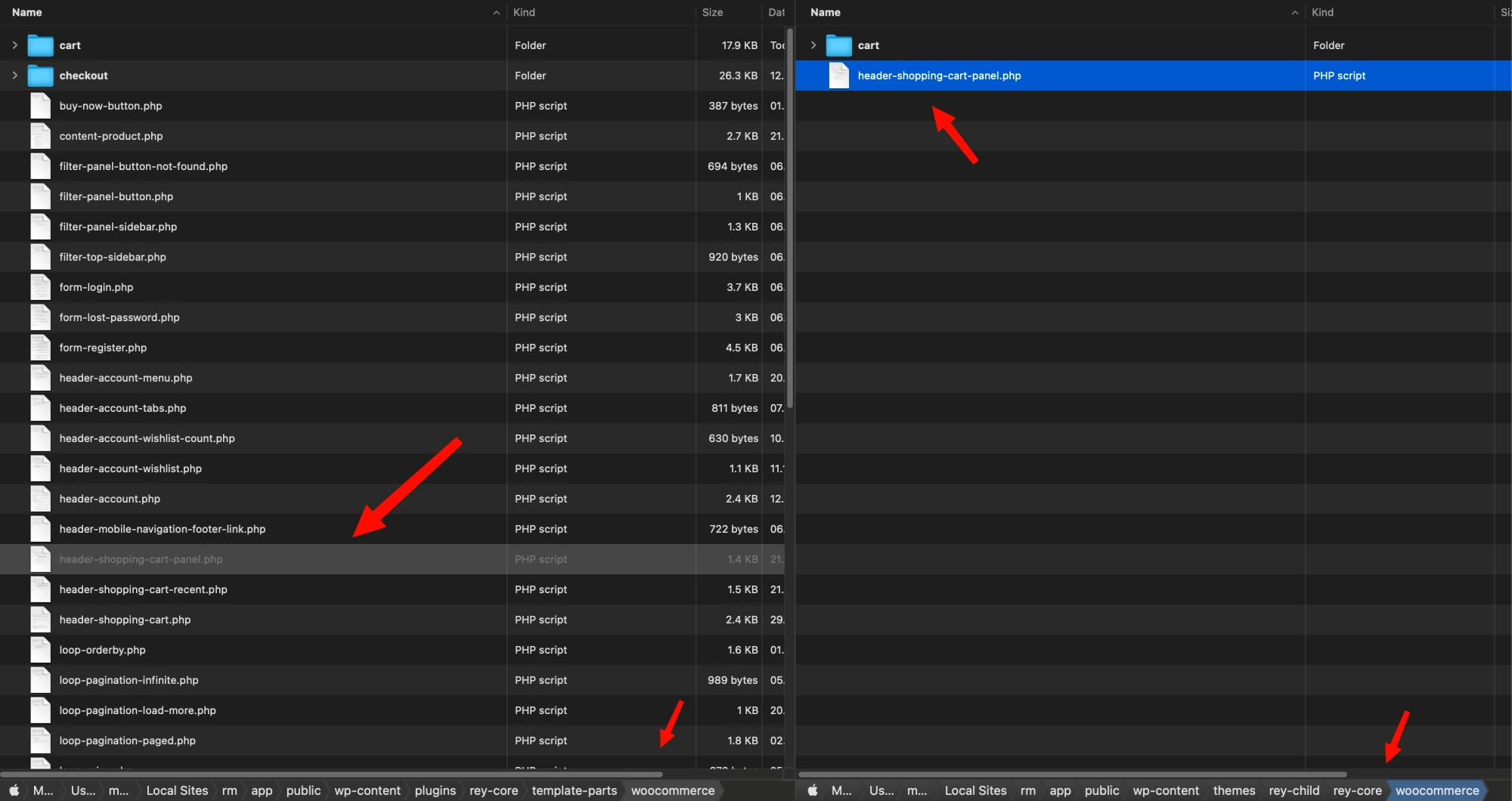
Rey Core, an example
The cart panel that slides in from the side is this file:
/wp-content/plugins/rey-core/template-parts/woocommerce/header-shopping-cart-panel.php
Drop template-parts/, put rey-core/ in its place, and keep the rest:
/wp-content/themes/rey-child/rey-core/woocommerce/header-shopping-cart-panel.php
Rey Theme, an example
The header logo is printed by:
/wp-content/themes/rey/template-parts/header/logo.php
Here the path is unchanged, only the theme folder differs:
/wp-content/themes/rey-child/template-parts/header/logo.php
WooCommerce, an example
The price block on a single product page:
/wp-content/plugins/woocommerce/templates/single-product/price.php
The templates folder is dropped, everything after it stays:
/wp-content/themes/rey-child/woocommerce/single-product/price.php
Note: Rey overrides a number of WooCommerce templates itself, to give them its own markup. If your copy of a WooCommerce template has no effect, Rey is most likely serving its own version of that piece: look for it in Rey Core’s template-parts/woocommerce/ folder and override that one instead.
Good practice
- Copy only the files you actually change. Every copied file is frozen at the version you copied it from, and stops receiving fixes and improvements. Two overrides are easy to maintain, twenty are not.
- Check your overrides after a major update. If a template changed upstream, compare it against your copy and carry the changes across. WooCommerce does this check for you under WooCommerce → Status, which lists outdated template overrides.
- Try a filter first. Many outputs can be changed with a hook from functions.php, and a hook survives updates without any maintenance. Overriding a whole template is the heavier option, worth it when the markup itself has to change.
The override is not being picked up
- The child theme is not the active theme. Check Appearance → Themes: it should be Rey Child, not Rey.
- The path or the file name is off by something. They have to match exactly, including the case of every letter. Most servers are case sensitive even when your own computer is not.
- You renamed the wrong folder. For Rey Core it is
template-partsthat becomesrey-core. The subfolders after it stay as they are. - Something is caching it. Rey remembers which file it resolved for each template. On a site with a persistent object cache (Redis, Memcached), flush that cache after adding a new override file. Page caching and PHP OPcache are worth clearing too.